Panic Around Artificial Intelligence
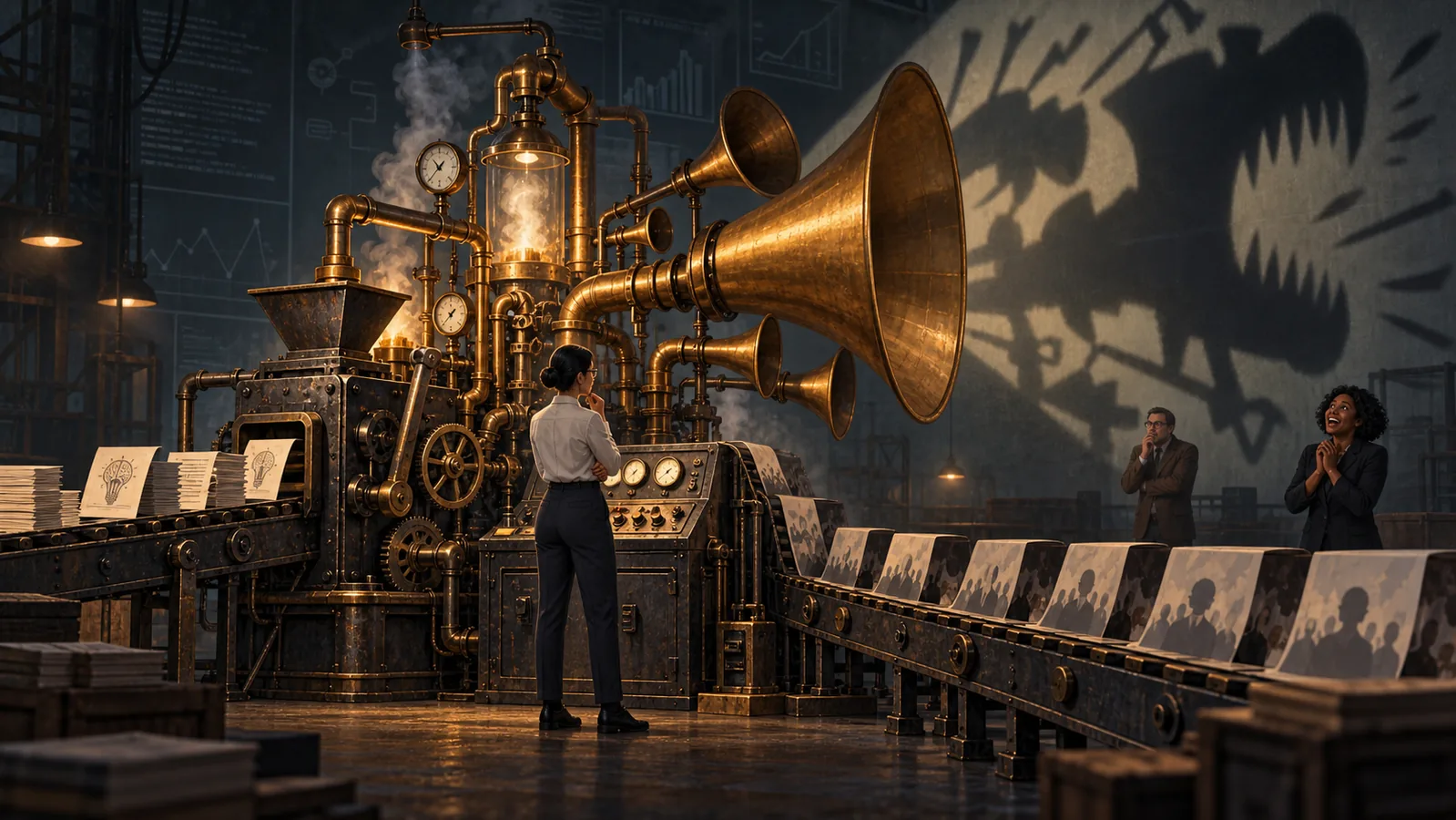
The Panic That Isn’t Quite Panic
I’m cheating a little with the title. Most of what surrounds artificial intelligence right now isn’t really panic. It’s an inflated idea of what AI can do and what its immediate future looks like. “Panic Around Artificial Intelligence” just sounds louder and better.
This panic includes everything at once. People are afraid of losing their jobs. They’re afraid the world is changing so quickly that we won’t recognize it in a couple of years. There’s the hype around AGI and the singularity. There are promises that AI will soon write all the code or replace <insert any profession>.
And pretty much everyone is feeding it. Corporations publish loud announcements and compete over whose model is more capable. The media retells those announcements even more loudly. Enthusiasts are waiting for a world where AI does all the work for us. AI opponents are waiting for roughly the same world, except they see it as a catastrophe—or desperately wait for the AI bubble to burst.
The result is a strange picture. AI is declared the savior of humanity, the cause of imminent mass unemployment, or almost an independent form of life. The ordinary, useful tool gets lost somewhere between those extremes.
The Lamborghini at Grandma’s House
Corporations benefit from talking about AGI, the singularity, and the incredible abilities of their own models. It’s ordinary PR activity that increases the importance of the company and its executives. That importance then turns into very material things: sales, investment, market capitalization, and the status of being a technology leader.
That’s why some corporate stories sound roughly like this:
“Our AI escaped its secure environment and hacked half the internet.”
“Our AI could hack the entire internet! But we keep it safely locked up and heavily restricted!”
It sounds like children arguing. One of them owns a Lamborghini and a powerful computer, but they’re at his grandma’s house in the countryside. The other owns a game that’s exactly like real life: you can walk through your own city, enter your own house, and find yourself sitting inside that house playing the same game. They can’t show you any of it, but it definitely exists.
After GPT-6 Astra was released, OpenAI president Greg Brockman said he personally believed AGI had been achieved, and ended his conversation with journalists by welcoming them to the AGI era. Nvidia CEO Jensen Huang followed by writing that AGI had arrived.
Can GPT-6 Astra really be called AGI? I doubt it. Yes, the model gets excellent results on certain benchmarks. Yes, it’s better than previous versions. But good numbers on a prepared set of tasks don’t demonstrate the emergence of general intelligence. New benchmarks will come out, and new models will once again score in the single digits on them.
Meanwhile, Nvidia’s gains from the AI boom are anything but abstract. In August 2026, the company reported quarterly revenue of $96.2 billion, twice what it had made a year earlier. The stock rally turned many of its employees into millionaires and multimillionaires. Bloomberg was already writing about this in 2024, before the latest records had even been set.
It’s hard to treat a statement from the head of the AI industry’s leading hardware vendor as a detached philosophical observation. Both he and his company have a direct interest in convincing the world that the AI revolution has already begun and now requires even more computing power.
I’m Not a Luddite
After all that, it would be easy to lump me in with people who fear progress and simply want to dismiss a new technology. But I’m not a Luddite. I use AI every day, both at work and in ordinary life. To me, it isn’t a toy I mess around with after every new release. It’s one of my main tools.
AI lets me do a lot of things noticeably faster. Without it, some tasks would take much longer. I might never have gotten around to some of them at all. This applies to my job, personal projects, knowledge base, and articles. AI gives my productivity a huge boost, and pretending otherwise would be strange.
The change is especially obvious in programming. It’s gradually moving from entirely manual work toward an AI-native approach. I can give an agent one task, work on another myself, launch several more processes in parallel, and then review the results. This isn’t just a faster autocomplete. It changes the way the work itself is organized.
The same thing is gradually happening in everyday life. People use AI for routine tasks, while companies add assistants to their products and automate work that used to be very difficult to handle with conventional algorithms.
AI will absolutely change the way things normally work. It already is. My point isn’t that today’s models are useless or that the entire boom is built on nothing.
The problem is the scale of the expectations. There’s a huge distance between “this technology is very useful and will change a lot” and “we already have AGI, and it will replace everyone soon.” Public discussion keeps trying to clear that distance with a single press release.
Progress Is Real, but It’s Slowing Down
I think modern models have already hit the limits of the current approach. That doesn’t mean new versions will stop coming out or that progress has stopped completely. There is progress, without question. It just isn’t nearly as noticeable anymore.
The latest releases—GPT-6 Astra and Claude Fable 5.1—didn’t impress me at all. They’re better than their predecessors, score higher on benchmarks, work autonomously for longer, and handle more complicated tasks. But I don’t feel like we’ve seen another major qualitative leap.
I like comparing this to processors. Moore’s law stopped working in its original, simple form a long time ago. Transistor counts can’t keep doubling every two years forever: processors are approaching physical limits, and every additional step is getting more expensive and difficult. Companies come up with new gimmicks and keep improving their products, but the pace of growth has slowed dramatically.
Something similar is happening with AI. Models get bigger, receive more compute, reason for longer, and are trained on more specially constructed tasks. But new data is no longer appearing at the same scale it was available during the early development of large language models. There are no radically new advances in reasoning on the horizon either.
Companies can keep squeezing improvements out of the current approach for a long time. They can make models cheaper, faster, easier to use, and more reliable. They can teach them to use new tools. They can invent another round of benchmarks and then train models to perform better on those benchmarks. All of that is real progress. It just doesn’t have to lead to the AGI we keep hearing about in presentations.
The next serious leap will probably require a different AI architecture. Right now, I don’t see a breakthrough idea on the horizon that would radically change the current trend. Development may remain on roughly the same path as modern microelectronics: improvements continue, but the old pace is gone.
The World Doesn’t Change at the Flip of a Switch
Even if a model several times better appears tomorrow, society still has enormous inertia. There’s always a delay between the arrival of a technology and its normal adoption, and sometimes the technology never reaches large parts of the market at all.
Plenty of companies still don’t know what Excel is. They still calculate everything by hand, produce reports on paper, and live with processes that haven’t changed in decades. Never mind AI-native workflows and autonomous agents.
There are enormous numbers of companies that haven’t been digitized at all. Their problems begin long before the question of choosing the right model. While one part of the industry argues over whether AGI has arrived, another is still copying numbers from one sheet of paper to another.
That’s why I don’t believe every part of life will change radically overnight. There will be changes. In some places, they’ll be fast and painful. In others, AI really will allow one person to do the work of several. But adoption will be uneven, and old processes and ordinary human labor won’t disappear just because another corporation produced a beautiful demo.
Some companies may even reject AI deliberately and turn out to be strategically right.
Humans Are at Least Predictably Problematic
Companies more or less understand the risks of human labor. There’s the bus factor, the incompetence of individual employees, burnout, conflict, resignations, and ordinary mistakes. All of this can be extremely expensive. But these problems have been studied for decades, and there’s an enormous body of management theory and practice built around them.
None of those practices offer guarantees. At least a manager has some idea of what class of problem they’re dealing with and what can be done about it.
AI is a hallucinating, unpredictable black box. It can forget instructions, suddenly start doing something completely different, or refuse to perform a task for some contrived reason. It can get stuck in an infinite loop, burn through an enormous number of tokens, and return something that still has to be redone by a human.
And it isn’t always possible to predict where this will happen. The cost is unpredictable too: an agent might finish a task quickly, or it might spend hours going in circles and generating expenses.
For a manager, this is a nightmare. They have to commit to deadlines, track costs, distribute responsibility, and understand why the work broke down. “The model acted weird this time” isn’t very useful when you’re trying to manage a project.
So a company that keeps human labor instead of adopting AI everywhere isn’t necessarily behind the times. It may simply have chosen familiar risks over new ones that are still difficult to manage. In some areas, that can be a perfectly pragmatic decision.
Pragmatism Instead of Extremes
Discussions about artificial intelligence keep collapsing into two extremes.
The first: AI will replace everyone soon, professions will disappear, code will write itself, and humans will either enjoy the singularity or search for a place in the new world.
The second: AI is completely useless, models only hallucinate, real work still has to be done by hand, and the entire market is held together by investor money and marketing.
I agree with neither.
AI is a very good tool. It already helps me work faster and do things that would have taken me much longer without it. Companies really are using it to automate routine work. Programming is already changing. Ignoring all of that is pointless.
But a tool doesn’t become AGI just because an executive with a stake in the outcome says it has. Model improvements are slowing down, adoption is running into social inertia, and AI’s unpredictability creates risks we’re still learning to control.
I think AI should be approached pragmatically. Look at where it actually helps, how much its work costs, whether the result can be verified, and what happens when it makes a mistake. Where the value is clear and the risks are manageable, it should be used. Where they aren’t, rejecting AI doesn’t make a person or a company a Luddite.
AI won’t replace everyone tomorrow. That doesn’t make it useless. The world will change more slowly, unevenly, and boringly than the loudest predictions promise.
And that’s probably fine.